Gardener's SecretsUpdated 5 November 2026
Best trees for small gardens, and how to choose one
In a small garden a tree is usually the largest thing you plant. Here's what to weigh before you buy: the size it will reach, its shape, its seasons and where its roots will go.
By Adam Baguley, Chief GardenerFirst published
Part 1
What makes a tree right for a small garden?
The best trees for small gardens are the ones that still fit the space in twenty years' time. The RHS puts height and spread first among the things to weigh when you choose a tree for a small garden.
A tree bought in a pot is a young plant. The label tells you what it should reach, and that is the figure to plan around, not the size it is on the day you take it home.
Beyond size, four questions decide the choice:
- What shape suits the space: upright, spreading, weeping or narrow?
- When do you want it to look its best, and for how long?
- Where will the roots go, and what is near them?
- Should it go in the ground, or in a large pot on the patio?
Each has a part below. Light matters too. A tree in the south corner of a small plot can shade the whole garden by midsummer, and your neighbour's as well. Stand where you want it, look at where the sun comes from, and think about where its shadow will fall at noon and in the evening.
The tree should also suit the soil. A few, such as amelanchier, which the RHS treats as acid loving, prefer a soil on the acid side. If you are not sure what you have, our guide to plants for clay soil explains the handful test.
Part 2
Height and spread, and how to read a label
The RHS gives a sharp warning: even small ornamental trees may in time reach 6 to 8m (20 to 26ft) or more. Its list of trees for smaller gardens takes in trees up to 8m, and it splits out a shorter list of those under 5m.
Heights on labels and in books are approximate. The RHS notes that where you are in the country, where the tree sits in the garden, the soil and the weather all change the height it finally reaches.
Read the label for:
- the height and spread it should reach, and roughly how long it takes;
- whether it is evergreen or loses its leaves in autumn;
- sun or shade, and the soil it prefers;
- whether the trunk has been grafted to keep the tree smaller.
The last point matters with flowering cherries. The RHS notes that several ornamental cherries are sold grafted on a short trunk, which keeps them to 3 to 4m.
Then measure your space. Take the spread on the label and check it fits without the branches pressing on a wall, a window or the fence. Allow for the trunk too: the RHS advises keeping paving and tarmac out of the circle about 1m round a tree's trunk, where the base thickens as it grows.
If the figures do not fit, choose a smaller tree, or one of the shapes in part 3.
Part 3
Shape, and when a shrub will do
When the height is too much, the RHS points to weeping forms, which rarely grow much taller than they are when planted. When width is the problem, it suggests a columnar tree, one that grows upright and narrow and does not spread far. Its top five for small gardens include Prunus 'Amanogawa', a columnar flowering cherry.
The shape also changes how much of the garden the tree takes up at ground level:
- An upright tree leaves room to plant and walk underneath.
- A spreading tree gives the most shade, and covers the most ground.
- A weeping tree makes a mound, and little grows under it.
- A columnar tree adds height without taking width, which suits a narrow strip or a corner by a fence.
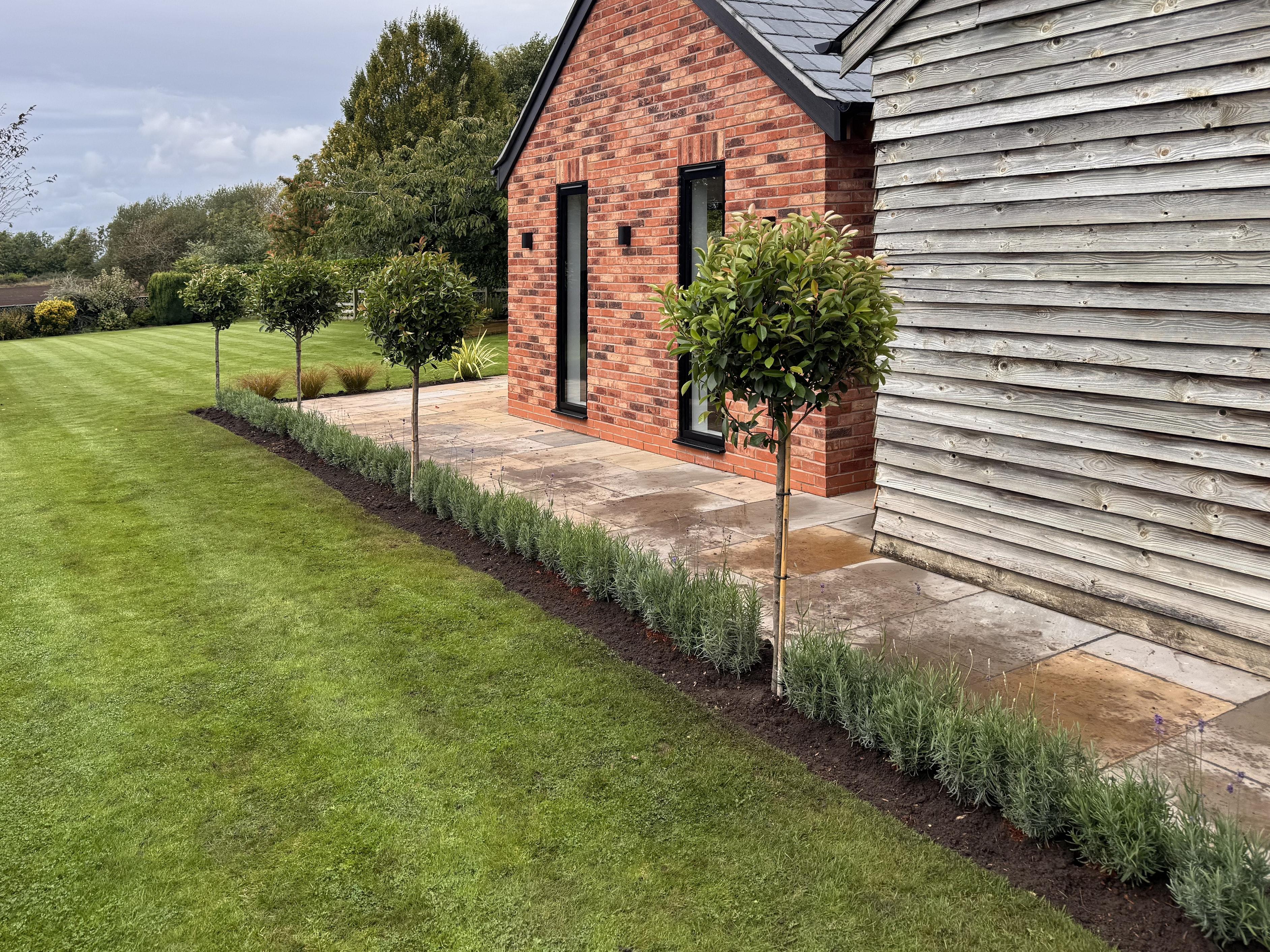
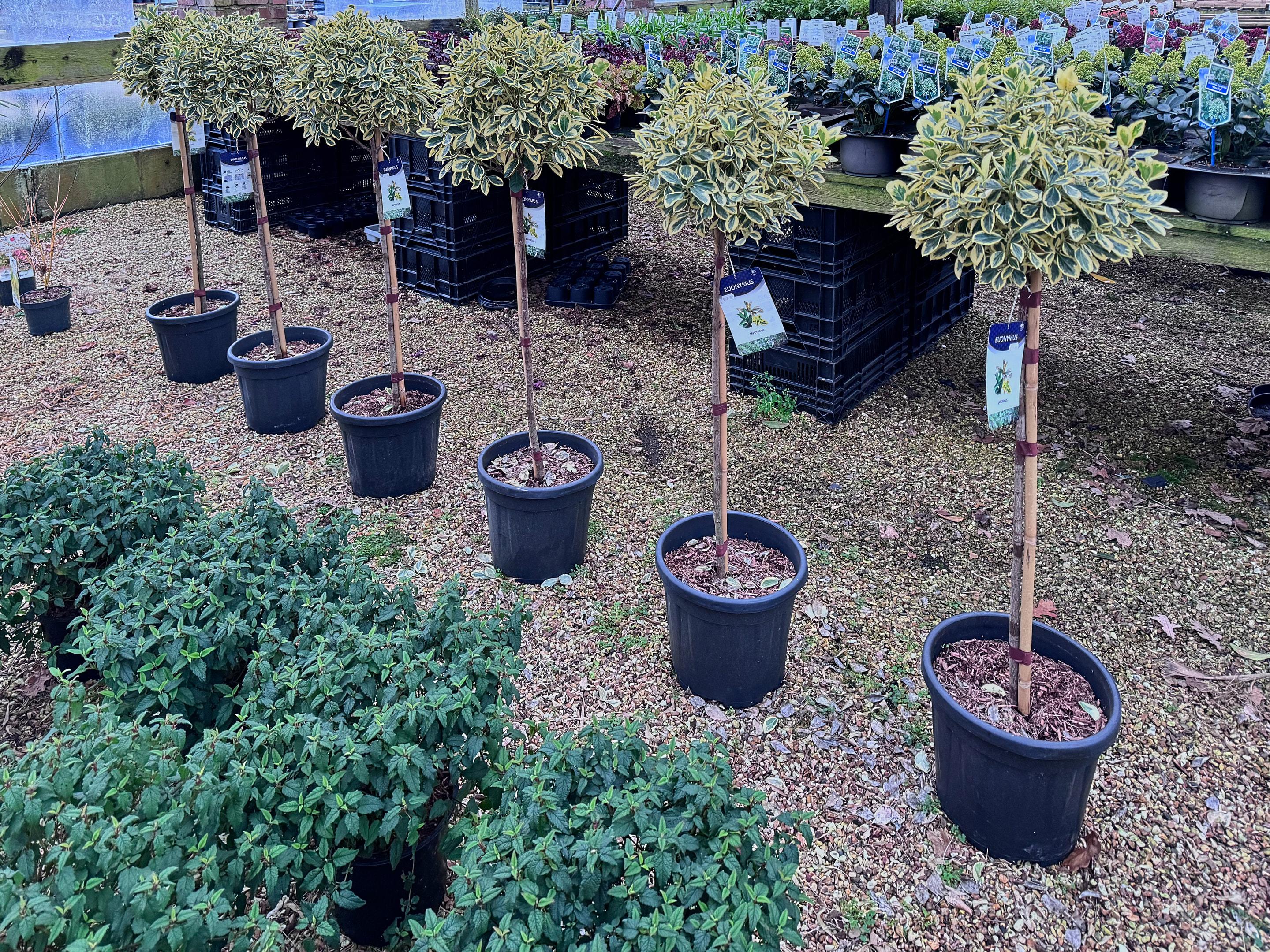
A large shrub can do a tree's job in a small garden. The RHS suggests choosing one when even a small tree would be too much. It also describes a way to get more from a tall shrub: as it grows, take off the lower branches so that the plant forms a head on a clear stem. The space underneath stays open for planting, and the leafy top carries on above a standard 1.8m (6ft) fence, which is useful where you want a little screening.
Think about the tree from the house as well as from the garden. A tree you see from the kitchen window every day gives you more than one in a far corner.
Part 4
More than one season
The RHS advises thinking about when you want the tree to look good: its flowers, its leaves, its fruit and its bark. If you only have room for one tree, it suggests one with more than one season of interest, such as fruit or autumn colour after the flowers.
The RHS top five smaller trees show how that works:
- Acer griseum, the paperbark maple, has bark that peels back to show cinnamon colour beneath, and rich autumn leaves.
- Amelanchier × grandiflora 'Ballerina' flowers white in spring, before bronze young leaves, and colours again in autumn.
- Crataegus persimilis 'Prunifolia', a hawthorn, flowers white in June, then carries orange red fruit and good autumn colour.
- Sorbus 'Joseph Rock' flowers in late spring, then has pale yellow fruit that turns amber, and red, orange and purple autumn leaves.
- Prunus 'Amanogawa' is narrow and upright, with scented shell pink blossom in mid to late spring.
These are the RHS's examples, not a list of what we have. What is on our tables changes through the year, so ask us what is ready this week and we will tell you what each one does through the seasons.
Evergreen or deciduous is part of the same choice. An evergreen keeps the screen in winter, but it casts shade all year. A deciduous tree lets the low winter sun into the garden and the house, and its bare branches have a shape of their own.
Part 5
Roots, walls and drains
The RHS is clear that most trees growing near buildings cause no damage. Where there is a risk, it comes from the soil more than from the tree.
On shrinkable clay soils, a thirsty tree can dry the soil under the foundations in a long dry summer, so that it shrinks and the building moves. The RHS explains that the risk is highest for older buildings. Houses built before the 1950s often have shallow foundations, while most houses built after 1980 have deeper footings, because Building Regulations came in during the 1970s.
How far the effect reaches depends on how much water the tree takes up. As a rule of thumb, the RHS says:
- for trees with a high water demand, expect the soil drying to reach out as far as the tree is tall;
- for trees with a lower water demand, it is unlikely to reach more than half the tree's height.
Among high demand trees it lists willow, poplar, oak, eucalyptus and Leyland cypress. Among low demand trees it lists magnolia, liquidambar, catalpa and hazel. Oak accounts for the most subsidence cases in the UK.
Drains are a separate question. Roots grow towards water, so they get into drains that already leak. The RHS notes that sound, watertight drains are not usually troubled.
Paving is the other common worry. Most lifting of drives and patios happens within about 1m of the trunk, and the RHS notes that cherries have roots close to the surface, which makes them more likely to lift paving.
If you are on clay and planning an extension near trees, the RHS advises asking a structural engineer.
Take care
Before you dig a planting hole, find out where drains, pipes and cables run. The RHS notes that a tree is the property and the responsibility of the landowner, who may be liable for damage it causes. If you live in a conservation area, or a tree already in the garden has a Tree Preservation Order, check with your council before you prune or fell it.
Part 6
Native trees for a small garden
If you want a tree for wildlife, a native one is a good place to start. The Woodland Trust points out that native trees are adapted to our climate and soils, which makes them easier to grow and more resilient. Its own list of native trees for small gardens includes crab apple, hazel, whitebeam, blackthorn, guelder rose and juniper.
The same list shows why the label matters. The Woodland Trust gives crab apple as able to reach 10m, growing around 30cm a year, and hazel as able to reach 8m. The Woodland Trust says the trees on its list are naturally on the smaller side, and that many trees can be pruned to keep them short or slim. Check the figure against your space before you buy.
Several of the smaller natives can also be grown as part of a hedge, which is another way to bring them into a small garden without the space a single tree needs. Our guide to native hedge plants covers mixing them.
What a native tree gives depends on the kind. The Woodland Trust notes that crab apple is good for insects, birds and small mammals, and that hazel feeds caterpillars, bees, birds and small mammals. Juniper, an evergreen conifer, gives birds food and dense cover for nesting.
As with the RHS examples, these are the Woodland Trust's suggestions, not our stock list. Ask us which native trees are ready, and bring the space you have.
Part 7
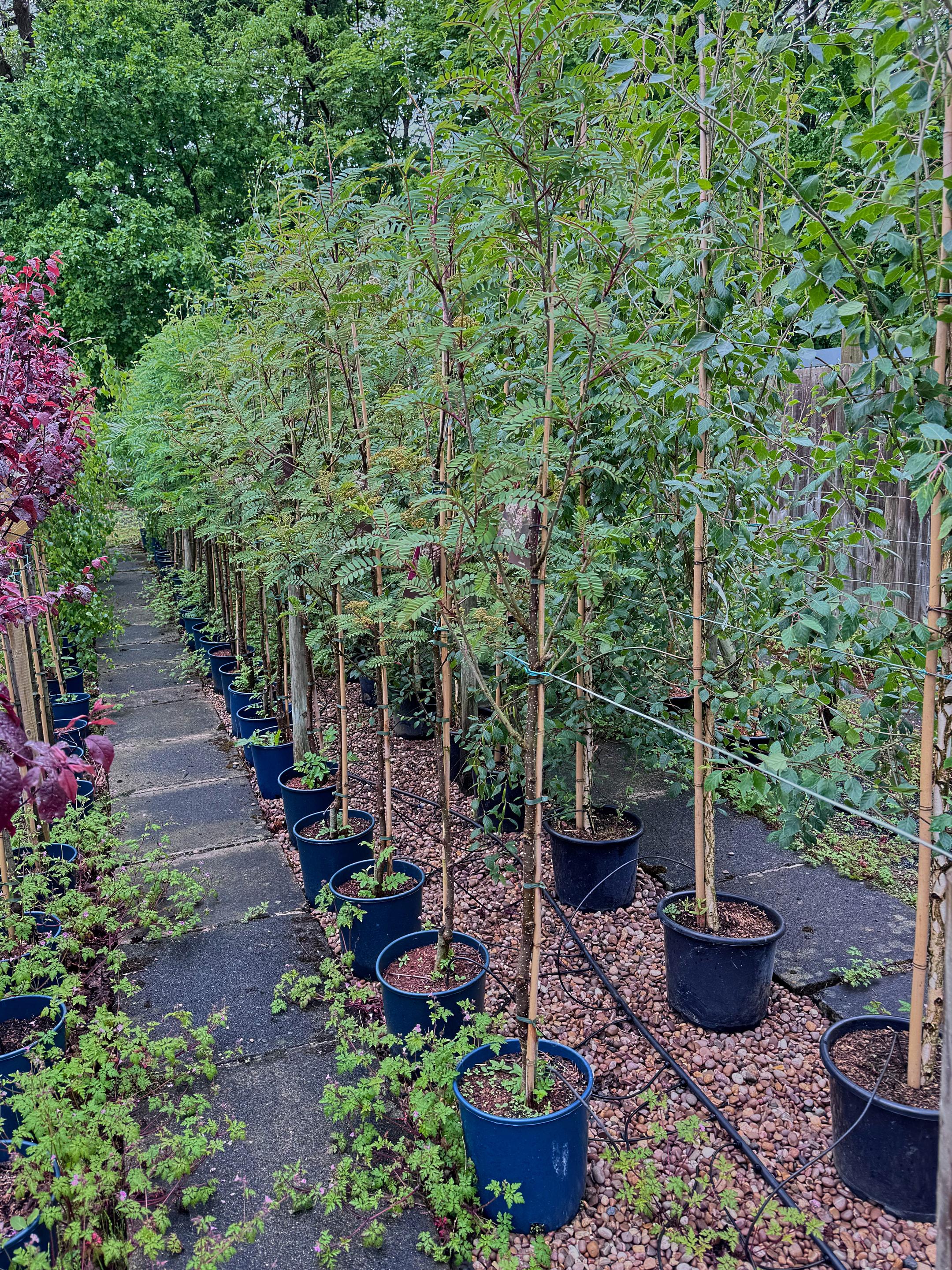
A tree in a pot
A tree in a container suits a patio, a yard or a garden with no open ground. The RHS calls it ideal for small gardens, and growing in a pot also holds a tree's size back.
What the RHS advises:
- Choose a pot with plenty of drainage holes. Do not put a small tree straight into a very large pot; move it up in stages, to a final pot of at least about 45cm (18in).
- Use a loam-based compost such as John Innes No 3, which is heavy enough to keep the tree steady. Acid lovers such as amelanchier need John Innes ericaceous compost.
- Water regularly. A tree in a pot dries out far faster than one in the ground, and the leaves often stop rain from reaching the compost. Keep it moist even in winter, when wind can dry it.
- Each spring, scrape off about 5cm of the old compost and replace it with fresh, with some slow-release fertiliser mixed in.
- In an exposed garden, wrap the pot in winter with bubble wrap or hessian, because the roots near the edge are open to frost.
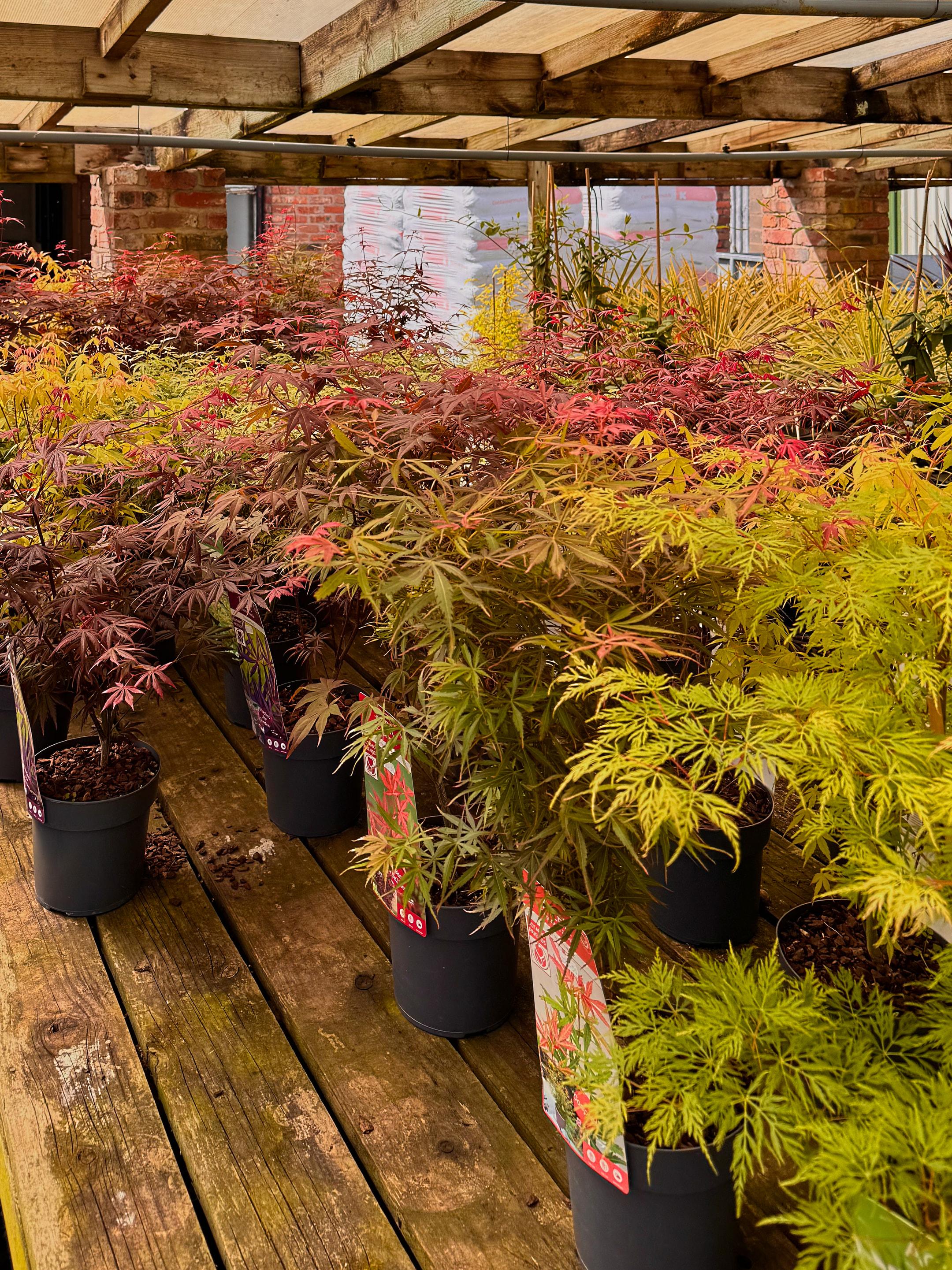
Heavy terracotta keeps a tree from blowing over but dries out faster; plastic is lighter and holds water better. The RHS names Japanese maple, olive and bay among its top trees for pots, and advises against fast-growing or large trees, which turn leggy in a pot. We sell compost alongside the plants, so ask the team which suits a tree in a pot.
Part 8
Buying and planting your tree
When you choose a tree, look at it closely before you take it home:
- Ease it out of its pot; the roots should fill it without circling tightly round and round.
- Pass over anything with damaged bark, dead leaves or signs of pests.
- A young tree should stand up with a short stake, not lean on a long cane.
The RHS finds that trees establish best when planted at no more than about 1.8m (6ft) tall. A smaller tree settles in faster and soon catches up.
A tree in a pot can be planted at almost any time of year, as long as the ground is not frozen or waterlogged, and the RHS counts autumn as a good time. Bare-root trees are sold from November to March, while they are dormant, and are lighter to handle. Our guide to planting a bare-root tree goes through it step by step.
Much of what is on our tables is grown on here from young plants, so the advice you get comes from the people who grew it. What we have changes through the year, so ask us what is ready this week, and bring the height and width you have room for. If you would like it planted, our own team plants trees too, staked and tied so they establish straight. We deliver across the North West, usually within two days.
To plant one in winter, read how to plant a bare-root tree, step by step. See what we have in trees and shrubs, or read more in the Gardener's Secrets guides.
Choosing a tree?
Bring the measurements of your space and ask us what is ready.
Ask us at the nursery
196 Manchester Road, Rixton. Bring the height and width you have room for, and a photograph of the spot.
Winter hours, until April · Mon to Sat, 9:00am – 4:30pmSundays closed