
Gardener's SecretsUpdated 5 November 2026
How to plant a bare-root tree, step by step
A bare-root tree planted well in winter is set up for years. Here's how we plant, stake and look after one, and what most often holds a young tree back.
By Adam Baguley, Chief GardenerFirst published
Part 1
When to plant a bare-root tree
Plant a bare-root tree while it is dormant, between November and March. That is our bare-root season, and the RHS gives October to April as the best time to plant trees and shrubs in general. A tree planted early in the winter has longer for its roots to start growing before the spring.
Within the season, the day matters more than the month. Plant when you can get a spade into the ground easily. Wait if the soil is frozen too hard to dig, or if water sits on the surface or pools in the bottom of the hole.
Bare-root trees have no soil round their roots, so they go in as soon as you can manage it. Plan the job for the day you collect the tree, or the next one. If the weather stops you, the tree can be heeled in until the ground is fit.
How to keep the roots safe until planting day, and how to heel a tree in, are covered in our guide When is bare-root season? What to know before you plant.
Part 2
Before you dig
Check the roots
Unwrap the roots and look at them in good light. The RHS advises choosing a bare-root tree whose roots spread evenly in all directions. They should be moist and flexible, with plenty of fine, fibrous roots as well as the thick ones. Cut back any broken or damaged roots to clean, healthy growth with sharp secateurs.
The RHS notes that young bare-root trees, one to three years old, establish well. A larger tree takes longer to settle and needs more care with staking and water.
Check the spot
Before you dig, picture the tree at its full height and spread, and make sure it has room above and around it. Ask us how big the tree you are choosing grows, if the label does not say.
Look at the drainage. On ground that stays wet through the winter, the RHS suggests choosing a tree suited to wet soil, putting in drainage, or planting on a low, wide mound, about 25 to 30cm high and 1m across.
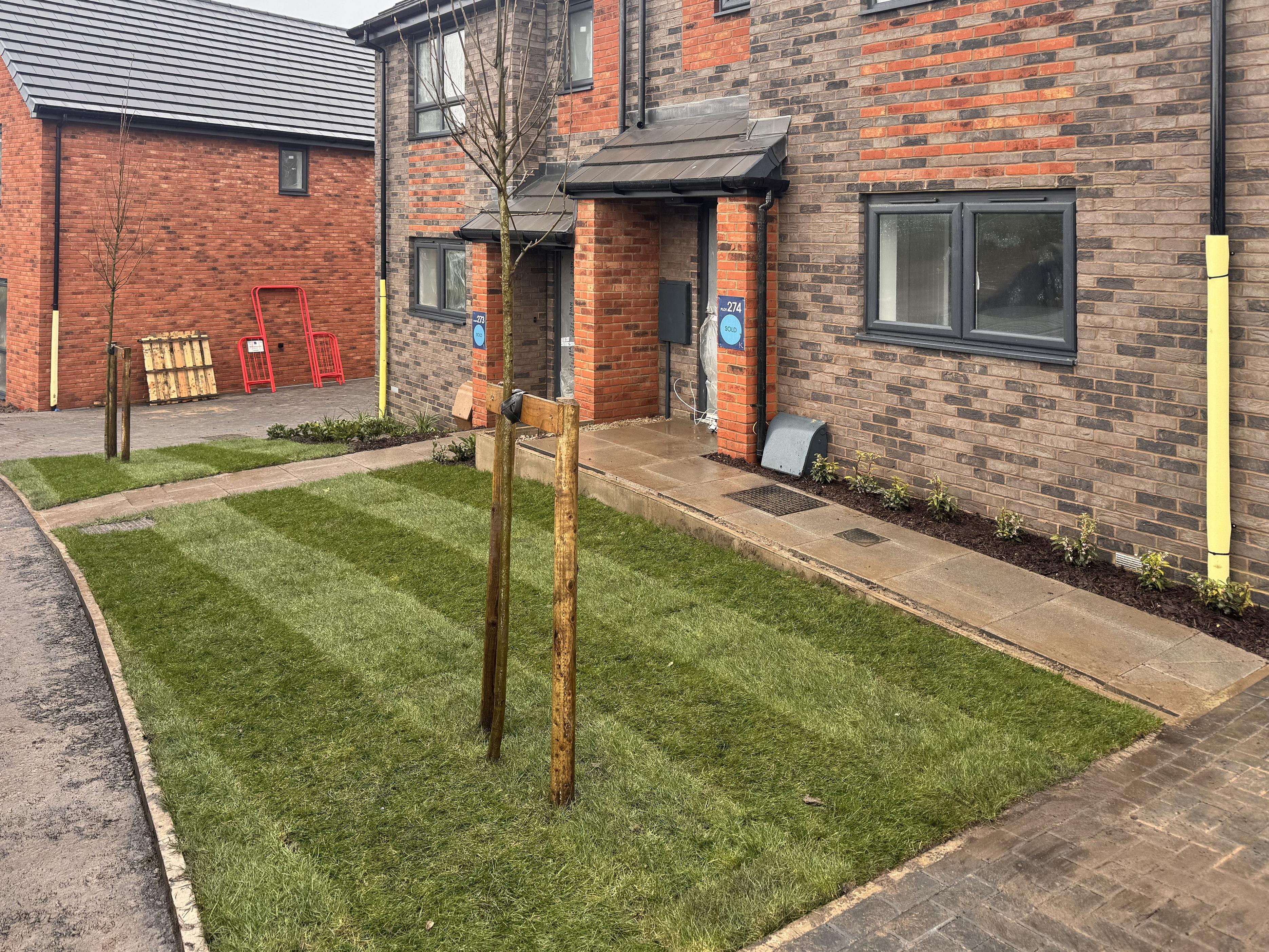
In a lawn, mark out the planting area first. You will keep a circle round the tree clear of grass for its first three years, so allow for that in the shape of the lawn.
Part 3
Digging the hole
The roots of a young tree spread out sideways, close to the surface, so the hole needs width more than depth. The RHS advises a hole no deeper than the roots, and ideally at least three times as wide as the spread of the roots.
Loosen the soil to the depth of the roots and over a wide area round the hole, so the new roots can grow out into it. If the sides of the hole are smooth or hard, as they often are on clay, break them up with a fork.
On heavy soil, the RHS notes that a square hole helps, because roots grow out more easily at the corners than round the smooth wall of a circle. In grass, a square hole inside a mown circle gives you both.
Keep compost and manure out of the bottom of the hole. The RHS finds little evidence that it helps, and as it rots it can let the tree sink below its planting depth. On poor sandy or heavy clay soil, mix some garden compost into the soil you put back round the roots instead.
There is no need to add fertiliser at planting time. On poor soil, the RHS suggests a sprinkling of mycorrhizal fungi on the roots can help a tree establish.
Part 4
Planting, step by step
With the hole dug and the stake to hand:
- Soak the roots in a bucket of water for about half an hour while you finish the hole.
- Knock in the stake now, before the tree goes in, so it cannot spear the roots later. Part 5 says where.
- Stand the tree in the hole and spread the roots out evenly.
- Lay a cane or the spade handle across the hole to check the depth. The point where the roots flare out from the trunk should sit level with the soil when you have finished.
- Put the soil back a little at a time, working it in between the roots with your fingers so there are no air pockets. Lift the tree gently once or twice as you go to settle the soil round the roots.
- Firm the soil gently with your heel. It should hold the tree upright without being packed hard.
- Water it in well, even in winter, to settle the soil round the roots.
- Tie the tree to the stake.
- Mulch the planted area, keeping the mulch clear of the trunk.
Our team plants, stakes and ties trees on jobs every season, bare-root in winter and potted the rest of the year. Of all the steps, take most care over step 4. The RHS names planting too deep as a common cause of death in young trees.
Part 5
Staking and tying
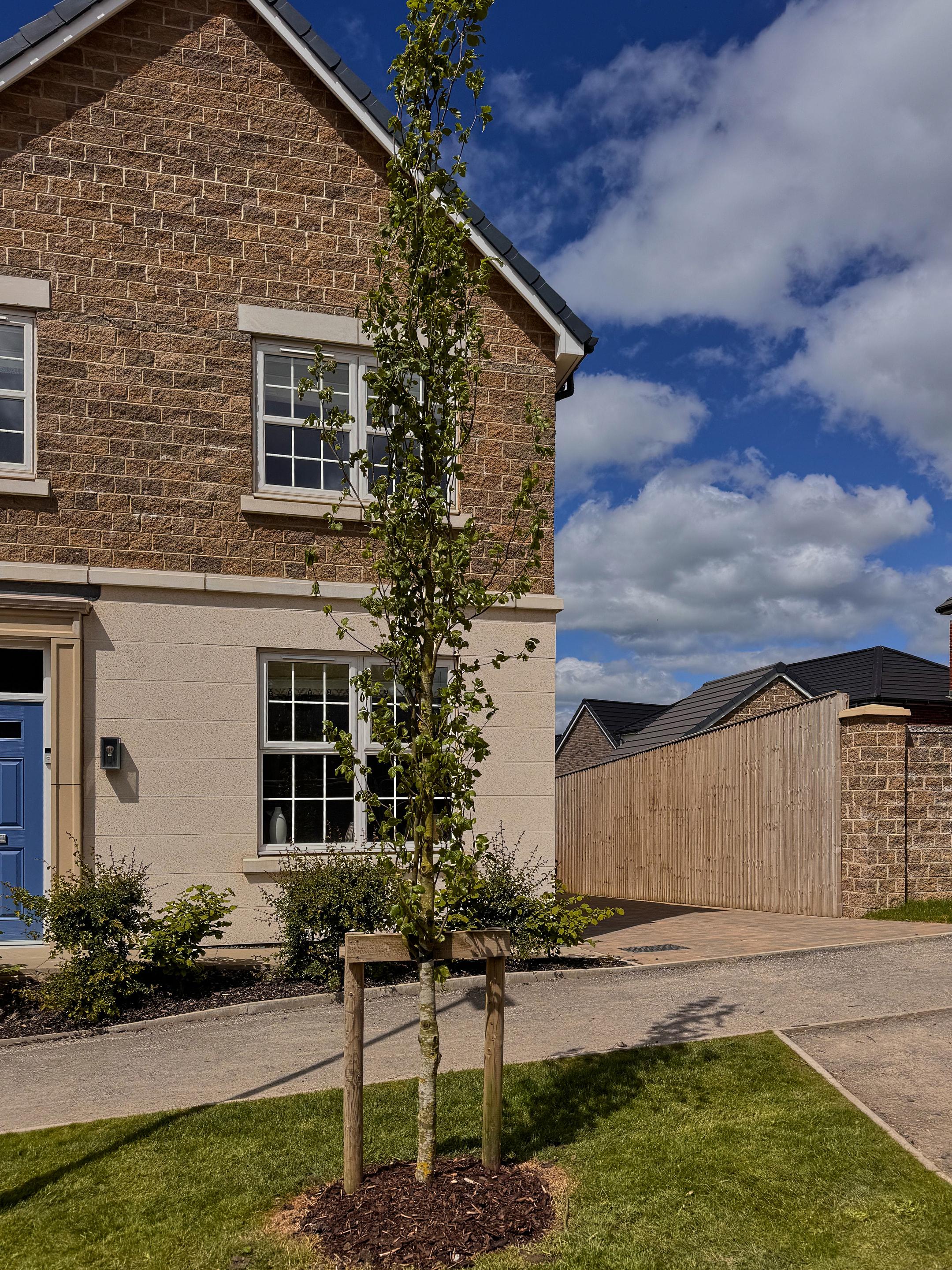
A stake holds the roots still while they grow into the soil, so the wind cannot rock the tree and tear the new roots. The RHS advises staking all but very small trees, those under about 140cm, and adds that a stake should still let the trunk flex a little in the wind, because that movement makes the trunk stronger.
For a young tree you can lift, one short stake is enough:
- Drive the stake in at an angle of 45 degrees, with its top leaning into the prevailing wind and its pointed end going in beyond the spread of the roots.
- Bury at least 40cm of the stake in the ground.
- Tie the tree to the stake about 40 to 50cm above the ground, or about a third of the way up the trunk.
- Use a proper tree tie with a spacer between the trunk and the stake, wrapped in a figure of eight, so the bark cannot rub.
On a windy site, on a slope, or for a taller tree with a broad head, the RHS suggests two upright stakes, one each side of the hole, joined by a crossbar that the tree is tied to.
Take care
Before you dig a hole or drive a stake in near a house, a drive or a path, find out where any buried cables and pipes run. If someone helps you hold the stake, they should hold it low and to one side, well clear of the hammer. Wear gloves and eye protection when you hammer.
Part 6
The first three years
Watering
Young trees suffer most from drought in their first few summers. The RHS points out that even in a cool, wet summer the rain rarely soaks right down to the roots, and the soil round them can be dry when the surface looks damp.
In dry weather during the growing season, the RHS suggests about 30 to 50 litres for each square metre a week, which is four to six full watering cans. If you are not sure, dig down with a trowel at the edge of the planting area and feel the soil. Too much water on badly drained soil rots the roots, so check before you water again.
Weeds and mulch
Grass and weeds take the water before it reaches the tree. The RHS advises keeping a circle at least 1.2m across clear round the tree for its first three years, by hand weeding, hoeing or a mulch mat. A mulch of bark or compost over the circle holds moisture in. Keep it about 10cm back from the trunk.
Leave the fertiliser for at least the first year. On very poor soil, a feed in the second season can help.
Ties, stakes and guards
Check the tie each spring and autumn, and loosen it as the trunk thickens, so it never cuts in. After bad weather, check that the stake is still firm. The RHS says a stake can usually come out after eighteen months to three years, once the tree stands firm on its own.
Where rabbits or deer visit, fit a spiral guard or a ring of wire netting round the trunk, so they cannot strip the bark.
Part 7
Why young trees fail
Most young trees that die in their first year or two die for one of a few reasons:
- Planted too deep, the cause the RHS warns about most.
- Dry roots. Roots left uncovered in the wind before planting, or a first summer without water.
- A tie left too tight, which cuts into the bark as the trunk grows.
- Grass and weeds round the trunk, which take the water and invite the mower and the strimmer close to the bark.
- Waterlogged ground, where the roots run short of air.
If a new tree looks unwell, with leaves that are small, brown at the edges or falling early, bring us a photograph of the tree and the base of its trunk. We can tell you what to check.
Part 8
Bare-root or potted?
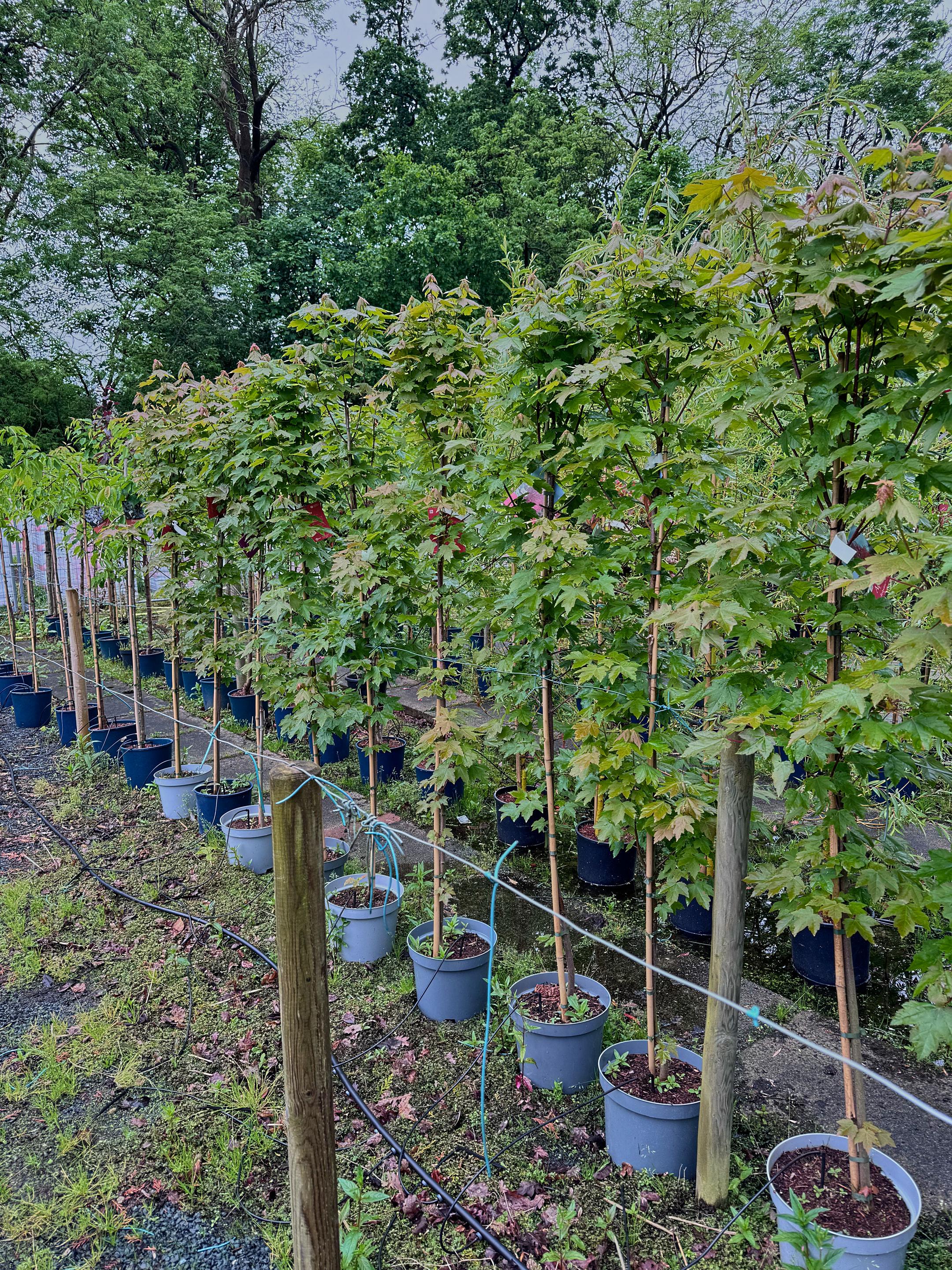
The same tree is often sold two ways. A bare-root tree is grown in the field and lifted in winter. It is usually the cheaper way to buy, and it can only be planted while it is dormant. A potted tree can go in at almost any time of year, though the RHS notes that one planted in autumn or winter needs much less watering than one planted in spring or summer.
That is why our team plants bare-root in winter and potted trees the rest of the year. What we have bare-root changes through the winter, so ask us what is in this week, and ring ahead if you have a particular tree in mind.
See what we have in bare-root trees and hedging and in trees and shrubs, or read more in the Gardener's Secrets guides.
Ready to plant a tree?
Bare-root trees are in from November to March.
Ask us at the nursery
196 Manchester Road, Rixton. Bring your questions about planting, staking or watering a new tree.
Winter hours, until April · Mon to Sat, 9:00am – 4:30pmSundays closed