
Gardener's SecretsUpdated 5 November 2026
Native hedge plants: choosing and growing a hedge for wildlife
A mixed hedge of native plants gives birds, insects and small mammals food and shelter through the year. Here's how to choose the mix, plant it and cut it at the right time.
By Adam Baguley, Chief GardenerFirst published
Part 1
What makes a hedge plant native?
A native plant is one that grew here naturally, without people bringing it in. The RHS describes British natives as the plants that were here during the last ice age or arrived on their own since. Hawthorn, blackthorn, hazel, field maple, holly and dog rose are among the plants most often used for a native hedge.
Native hedge plants matter for wildlife because our insects, birds and mammals grew up with them. Native shrubs flower when local insects need nectar, their leaves feed the caterpillars of our own moths and butterflies, and their fruit ripens as birds need it in autumn and winter.
That does not make every garden plant from elsewhere useless. Plenty of garden shrubs feed bees. A native hedge is simply the surest way to feed the widest range of wildlife from one strip of ground.
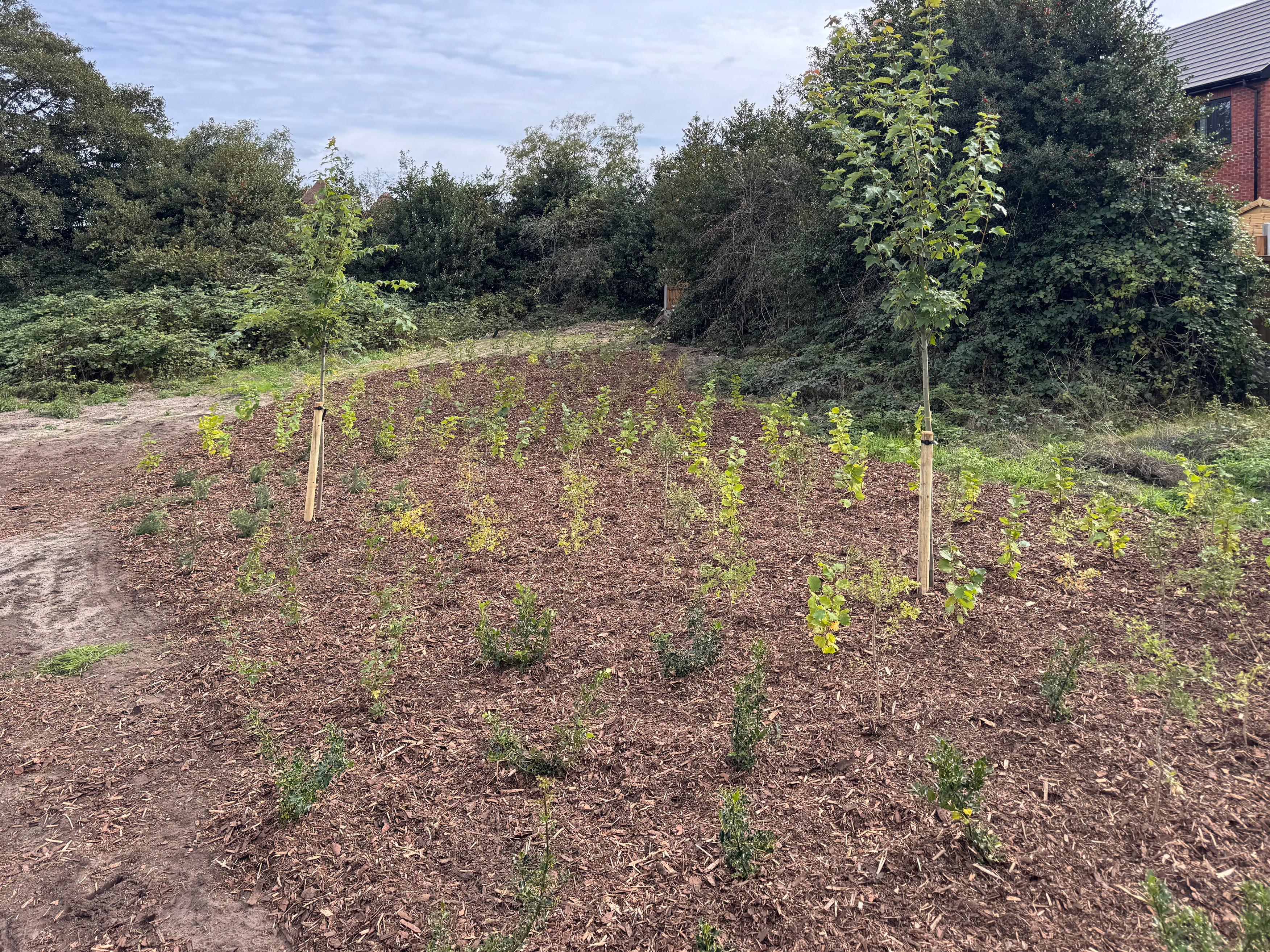
Most native hedging is sold bare-root, as young plants called whips, during the dormant season. It is usually the cheaper way to plant a long hedge.
Part 2
Why a mixed native hedge is good for wildlife
A wildlife hedge works like a long, thin wood. The RHS sets out what a mixed native hedge gives through the year:
- flowers in spring for bees and other pollinators;
- leaves for caterpillars, which in turn feed birds and their young;
- berries, hips and nuts in autumn and winter, when food is short;
- dense branches for nesting birds, and shelter at the base for small mammals.
The Woodland Trust adds that bats follow hedges to find their way at night, and that an estimated half of Britain's hedgerows were lost from the countryside during the 20th century. A garden hedge cannot replace that, but a run of gardens with hedges instead of fences gives wildlife a way through a housing estate.
A mix does more than a single kind. Each plant flowers and fruits at a different time, so something is in flower or in berry for much of the year. Blackthorn flowers in March, before its leaves, and is an early source of nectar for solitary bees. Hawthorn follows in May. Holly berries last into the winter.
A hedge also does the jobs a fence does: it marks the boundary and, once grown, gives privacy. The RHS adds that a deciduous hedge filters winter wind, where a solid barrier can cause damaging gusts.
Part 3
Choosing the mix
A backbone
Most native hedges are built on one or two plants that make up the bulk of the hedge. Hawthorn is the usual choice. The Woodland Trust describes it as suiting most soils, tolerating exposed sites and supporting hundreds of species, with blossom in May and red haws from late summer. Its thorny growth makes a dense, stockproof hedge. Field maple, which the RHS suggests for medium to large hedges, is another.
Variety through the year
Add a few other kinds through the row, spread out so the hedge looks even:
- blackthorn, for early blossom and sloes;
- hazel, for catkins in late winter and nuts in autumn;
- dog rose, for summer flowers and hips;
- guelder rose or dogwood, for flowers and berries, and dogwood's red winter stems;
- field maple, for yellow autumn colour.
Something evergreen
A hedge that loses all its leaves is open in winter. Holly adds evergreen cover for roosting birds, and the Woodland Trust notes that hedgehogs use the leaf litter beneath it. Holly is slow and only female plants berry, so it is planted in small numbers through the row.
What we have changes through the winter, so ask us what native hedging is in this week, and tell us the length and the spot. We can talk through what goes together.
Take care
Some native hedge plants are poisonous. The RHS lists yew as toxic if eaten, and spindle and purging buckthorn as harmful if eaten. Where children or pets play, or the hedge borders a field with animals in it, leave these out, and never leave clippings where animals can reach them. Teach children not to eat berries from any hedge. Wear thick gloves to handle hawthorn, blackthorn and holly.
Part 4
Fitting the hedge to your garden
A native hedge has to suit the spot as well as the wildlife. Before you choose, look at:
- Soil. Hawthorn grows in most soils. Beech dislikes waterlogged ground, so on heavy, wet clay hornbeam is the safer choice; the Woodland Trust calls hornbeam tough on exposed sites.
- Shade. Holly and yew take deep shade. Most flowering hedge plants flower and fruit best in sun.
- Space. A mixed native hedge is usually left about 2m tall and 1.5m wide, which is the Woodland Trust's description of a typical hedge. Allow for that width when you plan the line.
- Neighbours. The Woodland Trust suggests planting 1 to 1.5m in from a boundary, and talking to your neighbour before you start.
- Animals. The Woodland Trust warns that oak and wild cherry are toxic to horses, so leave them out next to a paddock.
- Neatness. Blackthorn spreads by suckers, so the Woodland Trust suggests it suits a wild boundary better than a neat one.
If you want screening in winter, beech and hornbeam are both native and both tend to hold their dry brown leaves through the winter, so they screen well without being evergreen.
If there is no room for a full hedge, the RSPB suggests what it calls a hedge wedge: a few hedge plants grown together in one small corner of the garden, which still gives birds food and cover.
Part 5
Planting a native hedge
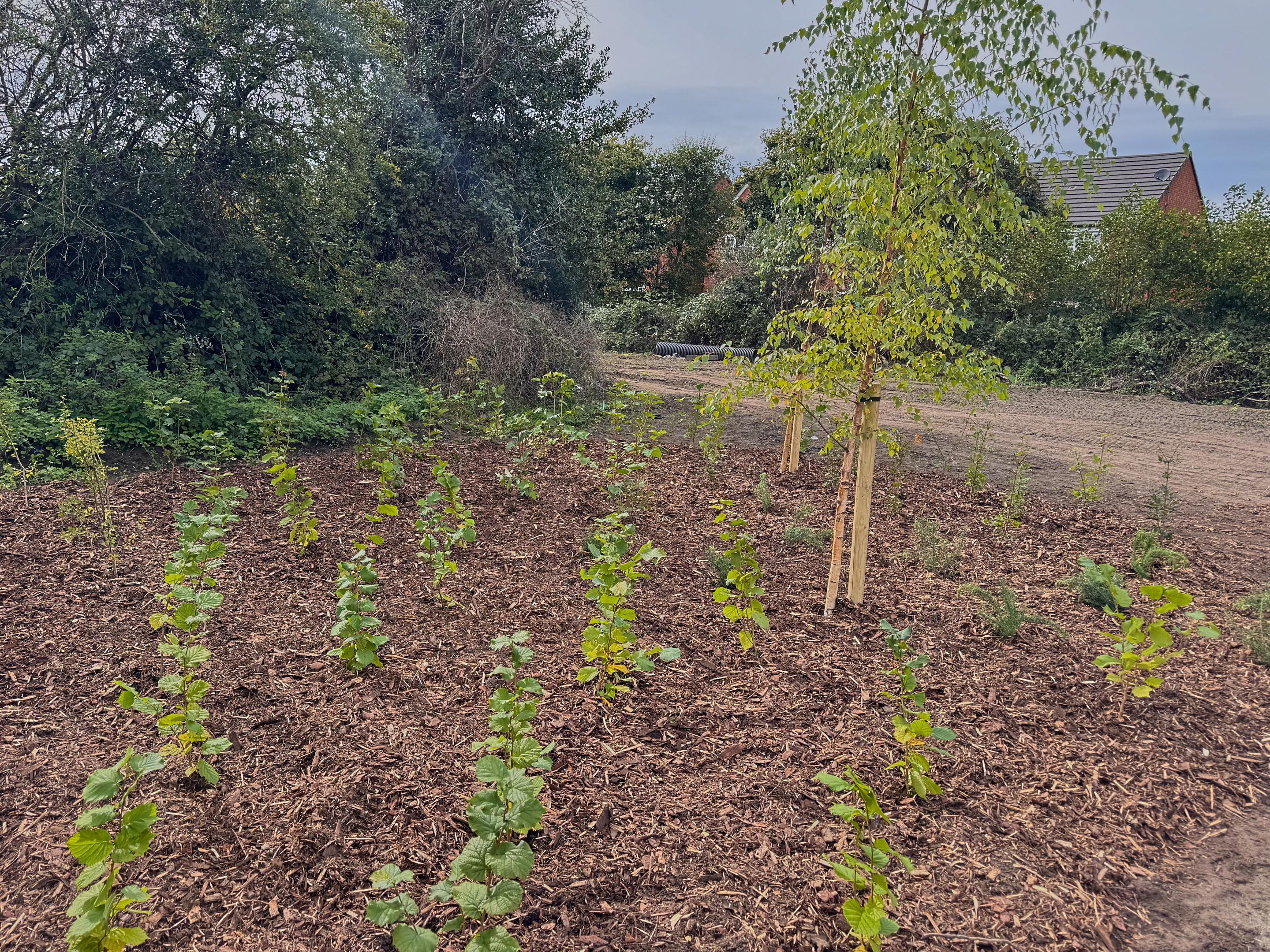
Native hedging is planted bare-root while it is dormant. With us, that season runs from November to March. The RHS suggests late autumn to late winter for a bare-root mixed hedge, so the plants are settled before they start growing in spring.
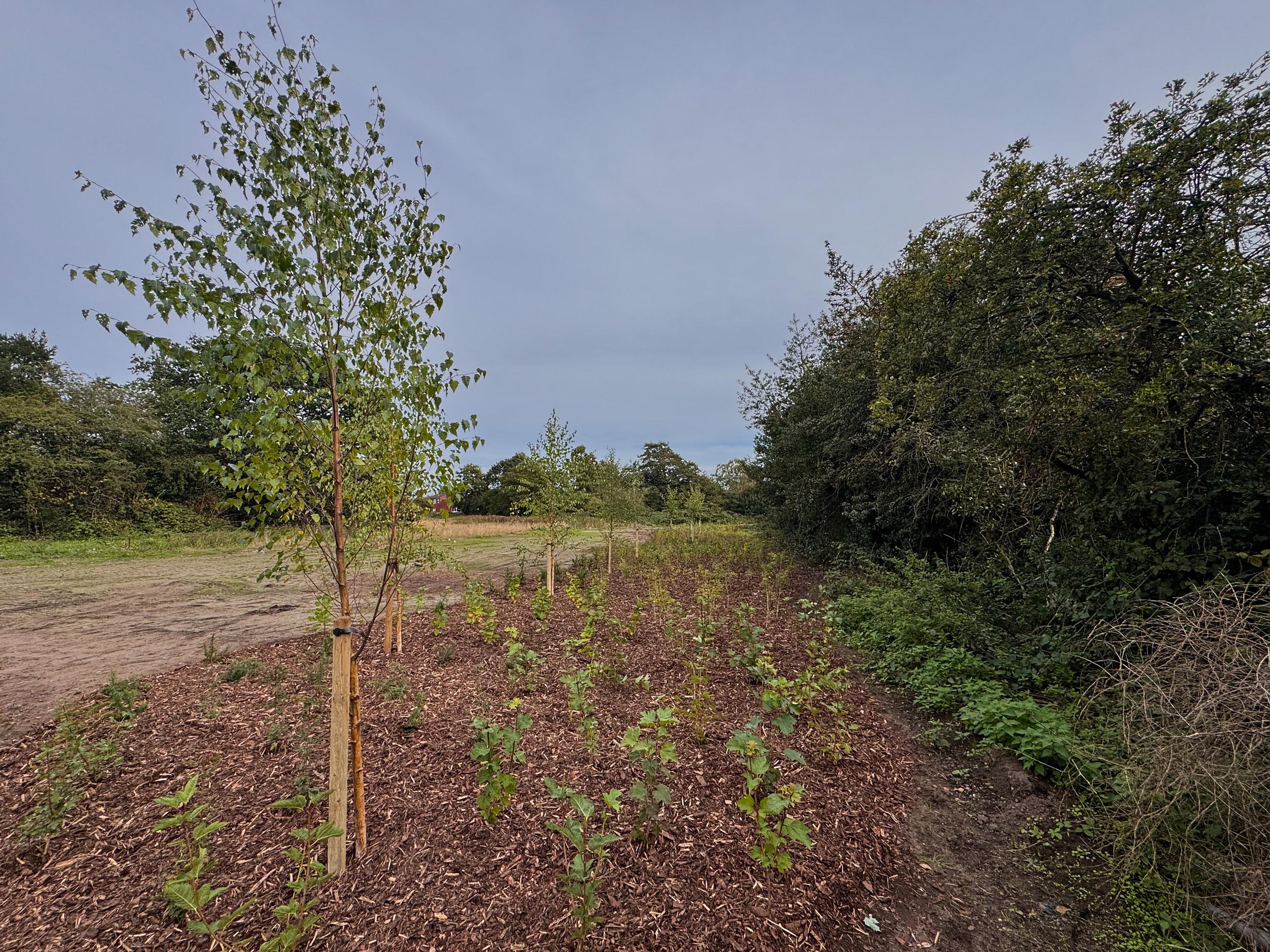
For a wildlife hedge, a staggered double row gives the thickest base. The Woodland Trust plants a zig-zag of about five plants to the metre, with 30 to 40cm between plants. Spread the different kinds along the row, so no stretch is all one plant. The Woodland Trust also suggests letting a tree grow up out of the hedge every 6m or so, protected with a tube and stake, to add height and more food for wildlife.
The RSPB suggests mixing garden compost or well-rotted manure into the trench, but not peat, and planting in a straight line or a soft wave for a more natural look. Firm the soil round each whip with your boot, water well, and mulch with bark to keep the weeds down.
Whips are small, often 20 to 90cm tall when they arrive, and look like bare twigs. That is normal. Kept weeded and watered in dry spells for the first few years, they knit together into a hedge.
The RSPB warns that a new hedge can be damaged by wind, drought and hard weather for its first two or three years. On an exposed site, a bamboo cane beside each whip helps hold it steady while the roots take hold. After a gale or a hard frost, walk the row and firm back in any whip that has been lifted.
Our own team plants new hedges along fence lines and round whole plots, from bare-root or potted plants depending on the season.
For the full method, from marking the line to the first cut, read our guide on how to plant bare-root hedging, from marking out to the first cut.
Part 6
Cutting a hedge for wildlife
A wildlife hedge needs cutting less often than a formal one. Many native hedge plants flower and fruit on the previous year's growth, so a hedge cut hard every year has few flowers and berries. The Woodland Trust suggests cutting an established wildlife hedge no more than every other year, or one side one year and the other side the next.
The best time is late winter. Hedge cutting is usually done between October and February, and the Woodland Trust recommends waiting for February, once birds have eaten the berries. The RSPB also advises cutting after the berries have gone.
Shape it wider at the base and narrower at the top. Light then reaches the bottom of the hedge, so it stays thick at the base, where wrens and other small birds feed and nest. Raise the height a little each time you cut, rather than going back to the same line, so the hedge keeps growing.
For a new hedge, the first cuts are there to make it bushy from the base. Both the RHS and the Woodland Trust give a method, and the hedge planting guide sets them out.
Part 7
Can you cut a hedge when birds are nesting?
You can cut a hedge at any time of year if no birds are nesting in it, but it is against the law to damage or destroy a nest while it is being built or used. GOV.UK sets this out under the Wildlife and Countryside Act 1981, which protects all wild birds, their eggs and their nests.
In practice, that means avoiding hedge cutting during the main nesting season. The RSPB gives this as March to August, and the Woodland Trust as March to September.
If a hedge has to be cut in spring or summer, for example where it blocks a path:
- look carefully into the hedge before you start, and watch for birds flying in and out with food or nest material;
- if you find an active nest, leave that part of the hedge alone until the young have left;
- trim only what you must, and leave the rest until the autumn.
Part 8
Leaving room for wildlife
A wildlife hedge works best a little untidy. The RSPB suggests leaving the leaf litter and seed heads at the base, where hedgehogs, insects and small mammals feed and shelter. Leave a strip of longer grass along the foot of the hedge if you can.
Do not plant climbers into a new hedge. The RSPB warns that they can smother young plants; once the hedge is established, honeysuckle or a native climber can go in.
Keep the base clear of weeds and grass for the first few years while the whips establish, then let it grow a little wilder.
See what we have this winter in bare-root trees and hedging, or read more in the Gardener's Secrets guides.
Ready to plan your hedge?
Bare-root hedging is in from November to March.
Ask us at the nursery
196 Manchester Road, Rixton. Bring the length of your hedge and a photograph of the spot, and ask us what native hedging is in this week.
Winter hours, until April · Mon to Sat, 9:00am – 4:30pmSundays closed