
Gardener's SecretsUpdated 5 November 2026
Winter hanging baskets: how to plant your own
A winter basket can carry colour by the door from autumn to spring. Here's how to plant one, which plants last through the cold, and how to see it through a frost.
By Adam Baguley, Chief GardenerFirst published
Part 1
When to plant a winter hanging basket
Plant a winter hanging basket in autumn, as the summer basket comes to an end. October is a good month for it. The compost is still warm, so the roots have a few weeks to settle before the cold slows everything down, and the basket has its colour in place for the shorter days.
Plants grow very little in winter, the RHS points out, so a winter basket will not fill out the way a summer one does. What you plant is close to what you will see until spring. Start with good-sized plants, and use enough of them to fill the basket on the day you plant it.
You can still plant one in November or December. The plants will sit more or less as you set them, so pack them in even more closely. Plant on a mild, dry day, when the compost and the plants' roots are not frozen.
If the summer basket is still flowering well in October, there is no need to rush. Many summer plants carry on until the first frost, and the bracket can wait a week or two.
Part 2
What you need
The RHS list for planting any hanging basket is short:
- a basket: wire, woven wicker or wood
- a liner, if the basket is wire: coir, jute, a ready-made liner, or a layer of moss raked from your own lawn, about 1.5cm thick
- peat-free multi-purpose compost
- the plants
- a hand trowel
- a short, wide pot or bucket to stand the basket on while you work
The RHS calls moss raked from your own lawn a thrifty option, and advises against buying sphagnum moss unless you are sure it was harvested from a sustainable source.
A peat-free multi-purpose compost is fine for a basket that only has to last one winter. If some of the plants are to stay in the basket for more than a season, the RHS suggests adding some loam-based compost, such as a peat-free John Innes mix. It holds water and food for longer, but it is heavier, so check that the bracket can take it.
Winter-flowering heathers prefer ericaceous compost, which is made for plants that need acid conditions. The RHS notes that Erica carnea and Erica × darleyensis are less fussy, so they grow happily in an ordinary basket mix.
We sell compost alongside the plants in Rixton. Ask the team which suits a basket.
Part 3
Winter hanging basket plants
Most winter hanging basket plants do one of three jobs: flowers for colour, foliage that holds the basket together, and bulbs that take over in spring. A mix of all three looks fuller for longer. Put something upright in the middle, something bushy to fill, and something trailing to spill over the edge.
Flowers for colour
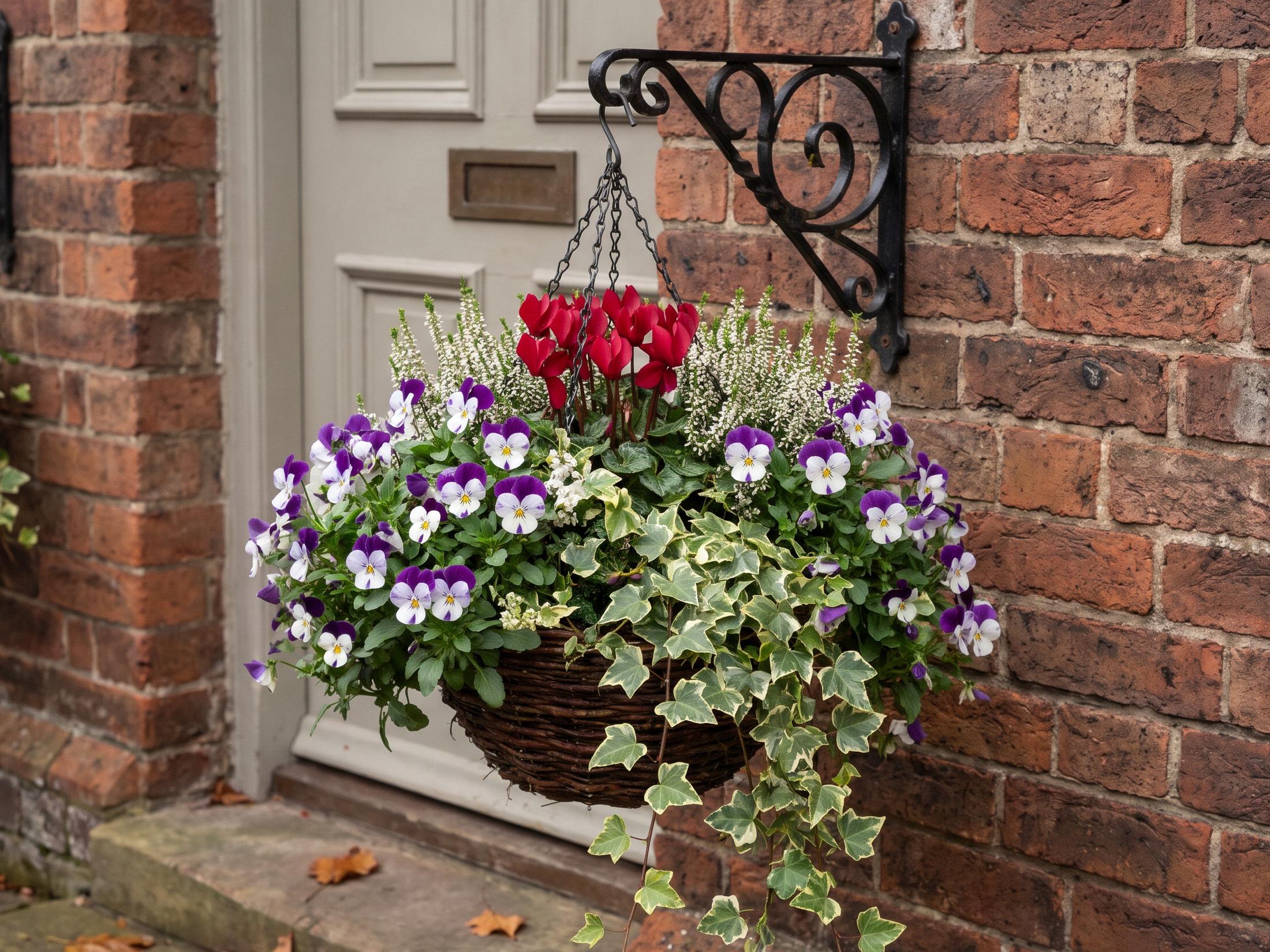
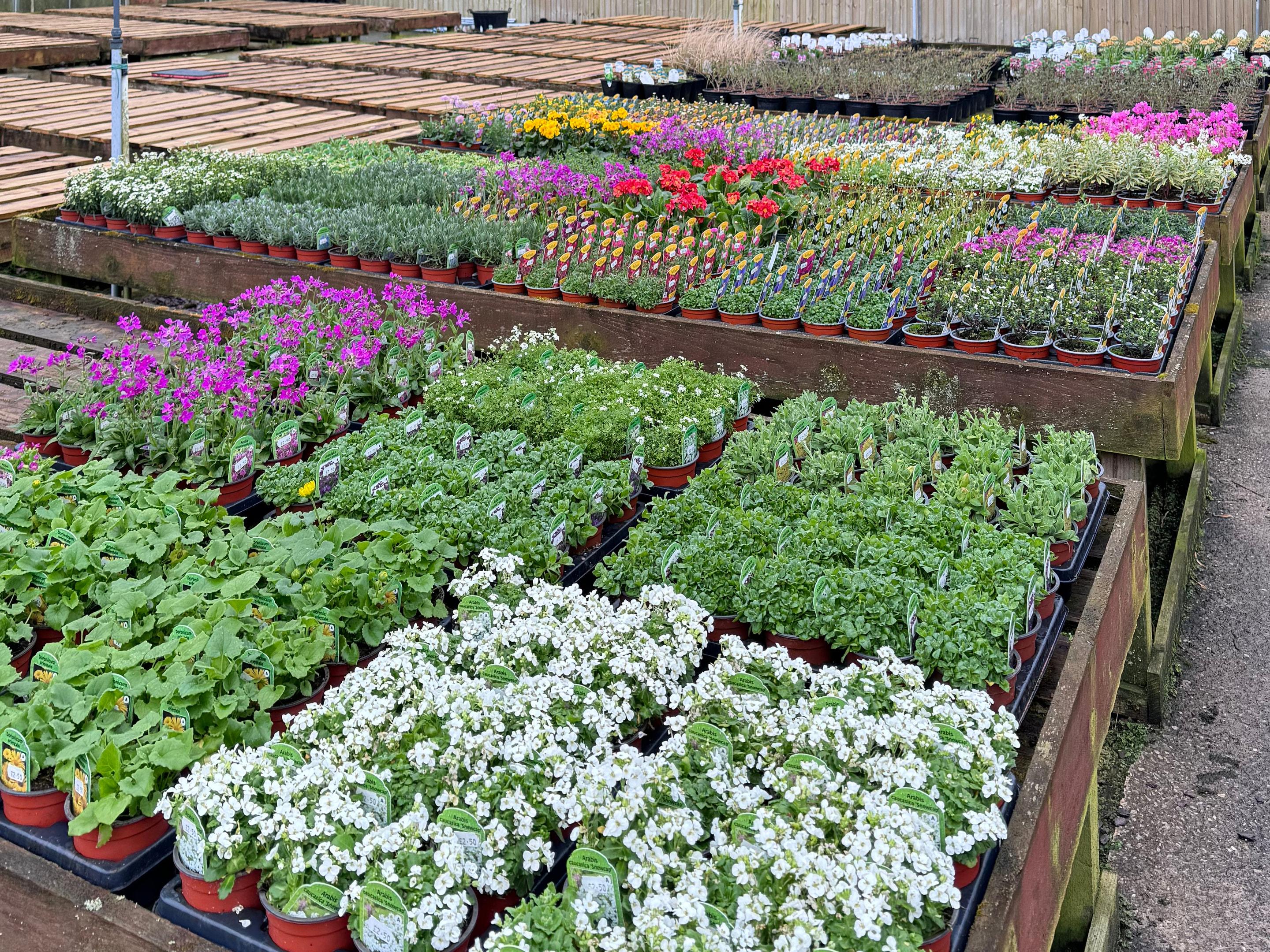
For winter baskets, the RHS suggests winter pansies and violas, primulas and polyanthus, small-flowered cyclamen and winter-flowering heathers. Most winter bedding flowers mainly in spring, the RHS notes, but cyclamen, winter pansies, violas, primulas and polyanthus flower on and off through the winter in mild spells. The larger florist's cyclamen, Cyclamen persicum, is not hardy. In a sheltered spot it usually lasts until the new year.
Foliage that lasts
Foliage carries a winter basket while the flowers pause. The RHS names ivy, plain or variegated, to trail over the edge; ornamental sedges (carex) for height and a fine texture; heucheras for their green or plum leaves; and small evergreen shrubs such as gaultheria. Evergreen herbs such as thyme and sage suit a basket in a sunny spot.
Foliage plants are also the ones worth keeping. When the basket is changed in spring, most of them can go into the garden or a pot.
Bulbs for spring
Tuck a few small bulbs in between the plants as you fill the basket. The RHS suggests crocus and dwarf iris (Iris reticulata) for baskets, and small daffodils such as 'Tête-à-tête' are among its top five plants for winter containers. They come up in late winter and early spring, just as the pansies and primulas reach their best.
What we have on the tables changes through the year, so ask us what is ready this week.
Part 4
Planting, step by step
The RHS uses the same method for summer and winter baskets:
- Stand the basket on the pot or bucket so it cannot roll.
- Line it, if it is a wire basket.
- If you want plants in the sides, cut a few slits in the liner at different heights, at least 10cm up from the base.
- Put compost in up to the level of the slits. Wrap the root ball of each side plant in a twist of newspaper, push it through the slit from the outside, then cover the roots with compost and firm gently.
- Add more compost and plant the top: the taller plants in the middle, the shorter and trailing ones round the edge.
- Set the bulbs between the plants, at the depth the packet gives.
- Fill round everything so the compost finishes just below the rim.
- Water slowly and thoroughly with a fine rose before you hang it.
Planting through the sides is not essential, the RHS adds, but it makes a basket look full sooner. That matters more in winter, when the plants will not grow to fill the gaps. Pack them closer than you would in May.
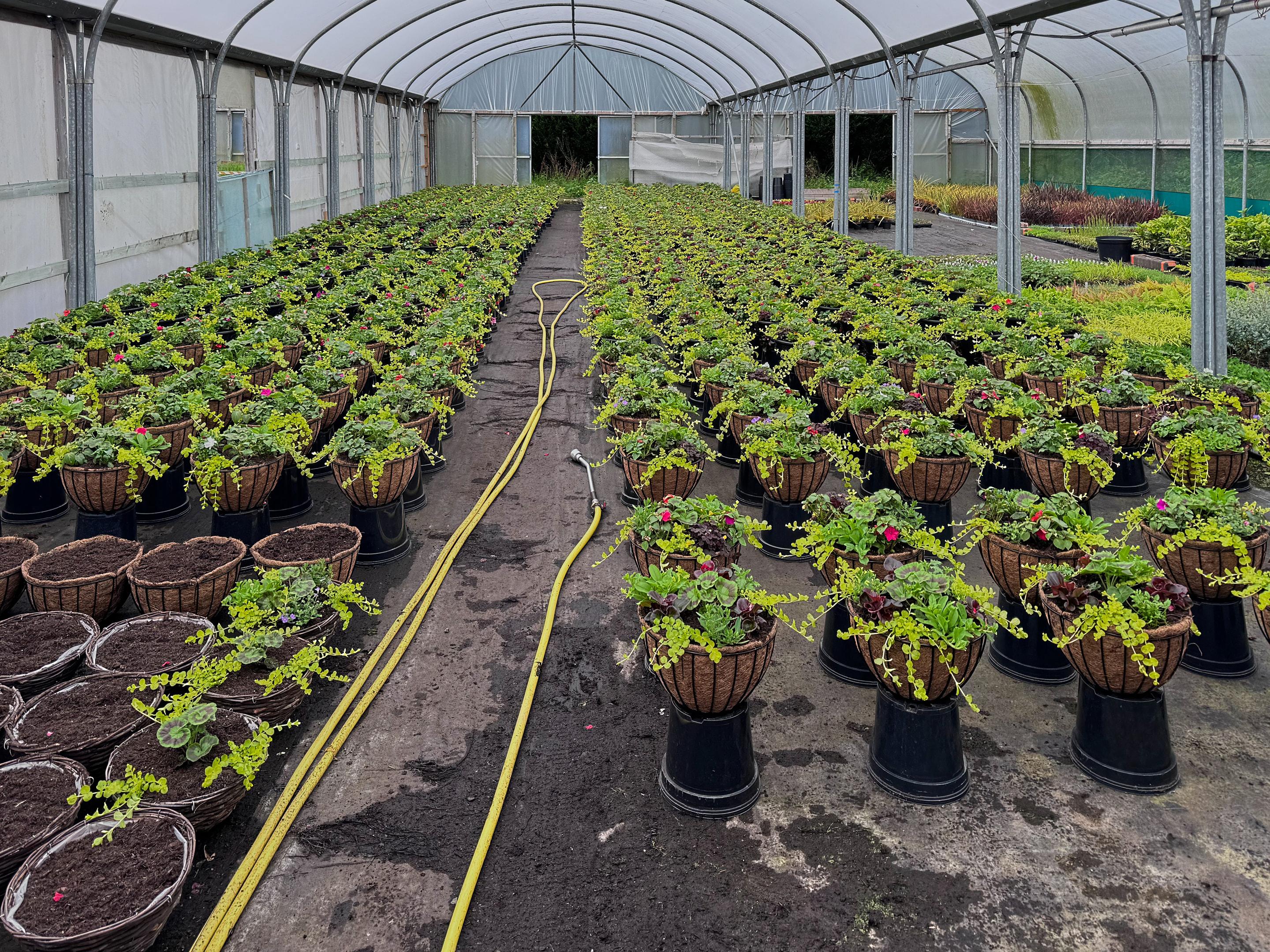
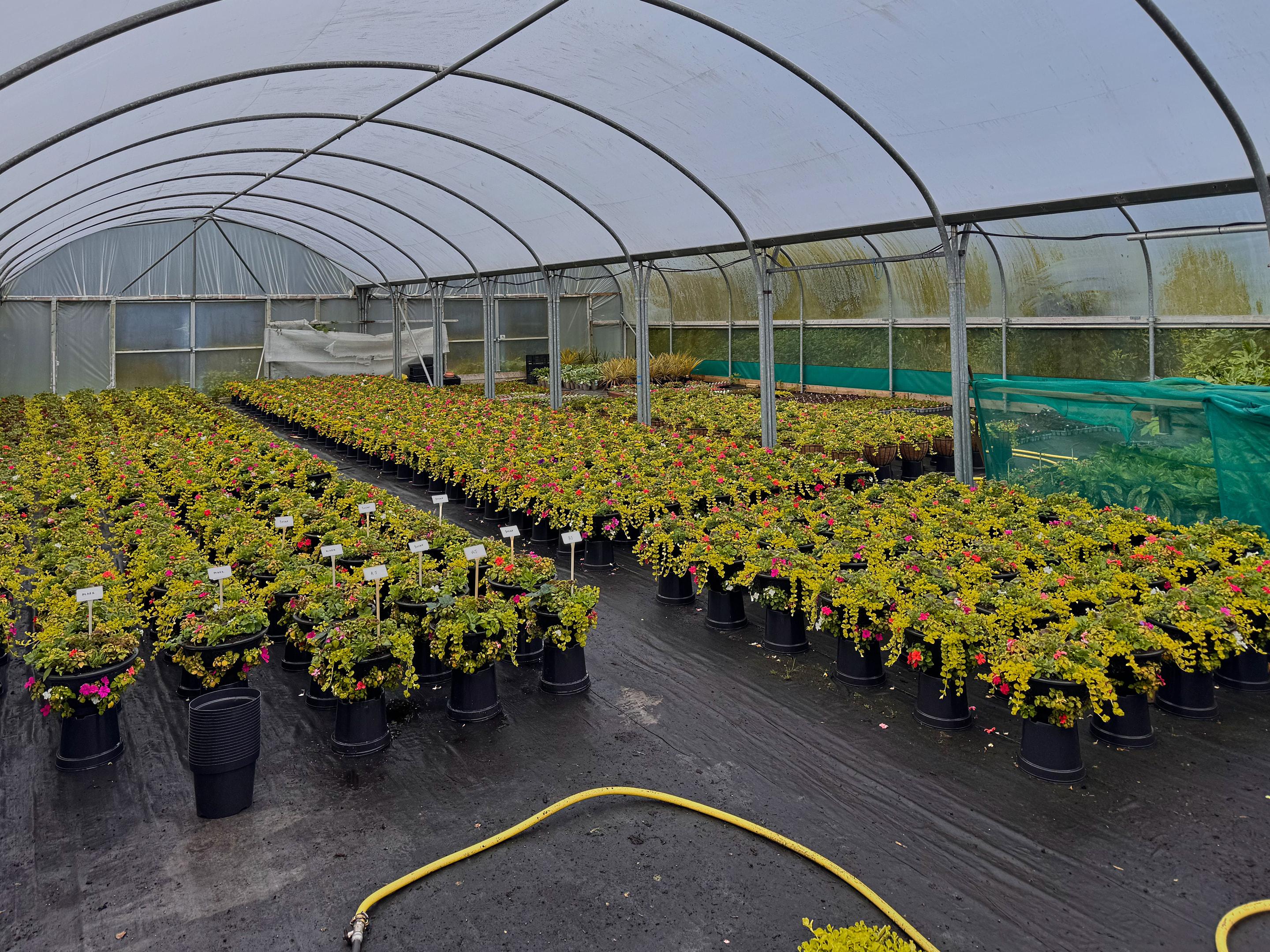
Our summer baskets are planted up and grown on in our polytunnel in Rixton. A winter basket goes together the same way, with tougher plants.
Part 5
Where to hang it
Hang a winter basket where it gets as much light as possible. The RHS notes that good winter light keeps foliage green and healthy. A wall that faces south or west is usually the brightest place through the winter months.
Keep it out of the worst of the wind as well. Wind dries a basket out, even in winter, and swings it on its bracket. A wall of the house that faces away from the prevailing wind gives it some shelter.
Hang it at a height you can reach to water it and to lift it down. You may need to take it down when a hard frost is forecast (part 7).
Check the bracket before the basket goes up. A basket of wet compost is heavy, and heavier still with loam-based compost in it. The bracket should be fixed into the wall with fixings meant for the weight, and checked each autumn.
Take care
Some plants that suit a winter basket are harmful if eaten. The RHS lists ivy, which can also irritate the skin, and the bulbs of daffodils, irises and tulips among them. Wear gloves when you plant, wash your hands afterwards, and hang the basket where children and pets cannot reach it. Clear up fallen leaves and flowers. If you think a child or a pet has eaten part of a plant, get medical or veterinary advice straight away. When you put a basket up or take it down, use a stable stepladder and have someone hold it.
Part 6
Looking after it through the winter
Watering
A winter basket dries out more slowly than a summer one, but the RHS says it still needs checking regularly. Keep the compost moist but not soggy, and water at the base of the plants rather than over the leaves and flowers. Mild, windy spells dry a basket faster than you might expect.
The easiest check is the one the RHS gives for any basket: lift or nudge it from underneath. A basket that feels light needs water. Water in the morning on a mild day, so the compost is not sitting wet when the temperature drops at night, and never water while the compost is frozen.
No feeding until spring
Winter hanging baskets do not need feeding. The RHS warns that feeding in winter encourages soft new growth, which frost damages easily. If there are small shrubs or perennials in the basket that you mean to keep, give them a slow-release fertiliser in spring.
Deadheading
Pick off faded flowers once a week or so. The RHS notes that regular deadheading keeps winter bedding flowering for longer, because the plant puts its energy into new flowers instead of seed. Pull off any yellow or rotting leaves at the same time, so they do not sit on the compost in the damp.
Part 7
Frost, wind and snow
The plants in a winter basket are chosen because they are hardy, but a basket hangs in the open air with only a thin liner round the roots. In a long, hard frost, the whole ball of compost can freeze.
When a hard frost or snow is forecast, lift the basket down and stand it somewhere sheltered for a few days: against the house wall, in a porch, or in an unheated shed or greenhouse. Stand it on its pot or bucket so it keeps its shape. Hang it back up once the frost lifts.
Knock heavy snow off the plants gently, so its weight does not flatten or split them. Pansies and violas that look limp after a frosty night usually stand up again as they thaw, so leave them be until then.
After a gale, check the bracket and the chains, and look for plants that have been loosened in the compost.
Part 8
What to keep in spring
A winter basket is often at its best from late winter into spring, when the pansies, violas and primulas put on their main flush and the bulbs come up. It can stay up until the summer bedding is ready to go out. The RHS puts that at the end of May or early June, once the risk of frost has passed.
Before you replant, lift out the plants worth keeping. Ivy, heucheras, carex and small evergreens can go into the garden or a pot. The RHS suggests planting the bulbs in the ground when you change to a summer display, so they flower again the following spring.
Spread the old compost on the garden as a mulch, and start the summer basket with fresh compost.
Our summer baskets go on sale from May, if you would rather take one home ready planted than plant your own.
For a summer basket, read our guide How long do hanging baskets last? Keeping one going all summer, see hanging baskets and seasonal colour, or read more in the Gardener's Secrets guides.
Ready for summer colour?
Our summer baskets go on sale from May.
Ask us at the nursery
196 Manchester Road, Rixton. Bring your questions about planting or looking after a winter basket.
Winter hours, until April · Mon to Sat, 9:00am – 4:30pmSundays closed